Select fiduciary services to help you run your medical practice. Get guidance on 401(k) plan administration, IRS testing, and government filings with expertise from Human Interest.
In-house recordkeeping
Automated plan administration tracks participation, contributions, distributions, and more.
Regulatory support
We reduce fiduciary liability by preparing select government filings. And for some clients, we sign and file the Form 5500.1
On-demand reporting
Get a 360-degree view of your plan, access reports, and see which employees have joined.
Plan compliance & testing
Don’t stress about IRS testing and regulatory deadlines. We’ll help handle them for you.
Connect your existing payroll provider
600+ integrations that automatically enroll employees and process contributions.
A 401(k) may be more affordable than you think.
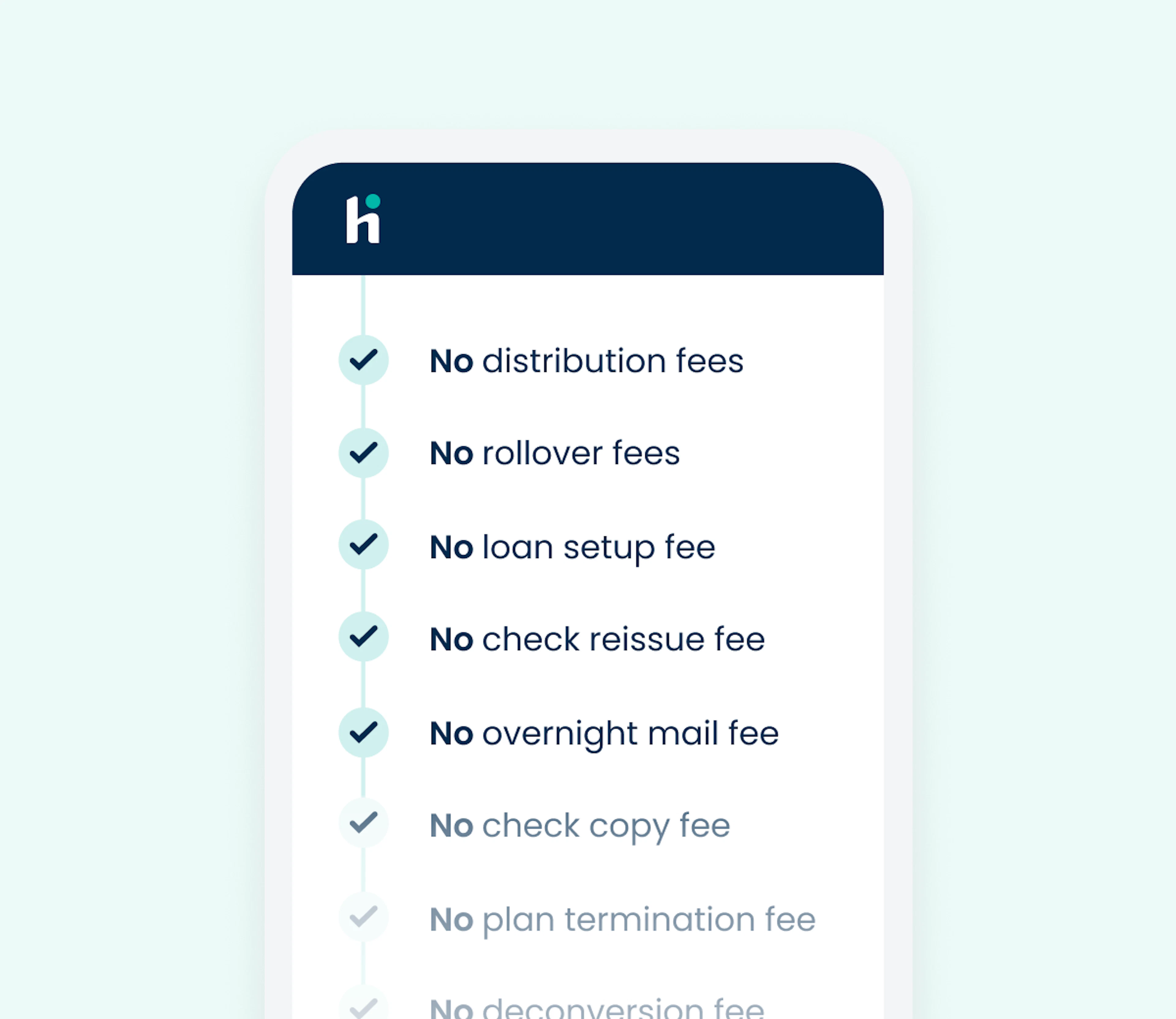
Get a customized, full-service retirement plan with transparent pricing, a $499 setup fee, and zero transaction fees*.
Investment Advisory services are provided through Human Interest Advisors LLC (HIA) to plans that select HIA as the investment adviser. HIA is a Registered Investment Adviser and subsidiary of Human Interest Inc. For such plans, a monthly investment advisory fee is paid to Human Interest Advisors (HIA) of 0.01% of plan assets when HIA acts as a 3(38) fiduciary, or 0.018% when acting as a 3(21) fiduciary. A separate fee for recordkeeping services and custody-related expenses is paid to Human Interest Inc. (HII) of 0.05% of plan assets. Asset-based fees are deducted monthly from the employee's account according to the HII Terms of Service and HIA Terms of Service. All prices are exclusive of applicable taxes. If the plan sponsor elects to hire an external investment advisor, the plan sponsor will pay such advisor as agreed between the plan sponsor and advisor. For more information, please see our pricing page.
* Applies to all transaction types. For non-rollover distributions, shipping and handling fees may apply to requests for check issuance and delivery.
401(k) Built to Scale with your Practice
Focus on running your medical practice. We’ll help with your retirement plan.
Designed to be easy to use. Flexible plan design allows you to customize eligibility and add employer match options.
Reduce manual work. In-house recordkeeping and ERISA compliance—plus select 3(16) Fiduciary Services depending on your plan.
Help drive employee loyalty. A Human Interest study found that a 401(k) is the most-wanted benefit, after health insurance.3
A 401(k) may mean mean additional tax credits for small business employers.
Employers may be eligible for tax credits of up to $5,000/year for three years for setting up a new 401(k) + $500/year for three years for setting up auto-enrollment.4
Sign up in minutes. Employees can sign up online—or on their phones—in less than five minutes.
Flexible investment options. Employers can select their lineup from our open architecture platform featuring thousands of mutual funds or utilize our 3(38) advisory services so their employees can access model portfolios that automatically rebalance.
Built-in education. Enrollment webinars and online resources help your team get the most from plans.
Currently, there’s no federal legislation requiring any employer to offer a retirement plan. However, since 2012, 46 states have either implemented a state-based retirement savings program, studied program options, or considered legislation in order to encourage people to save for their future. Additionally, there are a handful of states that have passed legislation requiring businesses to offer a state retirement plan to their employees if they do not offer another retirement plan such as a 401(k) or 403(b).
A 3(16) fiduciary is a service provider hired by an employer to function as a “Plan Administrator,” by fulfilling a comprehensive set of duties that many plan sponsors find demanding, including keeping the plan in compliance with ERISA guidelines. Overall, the purpose of a 3(16) fiduciary is to take on all or some of the medical practice's fiduciary duties related to plan administration and reduce the administrative hassle involved in managing a 401(k) or 403(b) plan and its assets.
For example, rather than the medical practice owner having to work through issues like loan and distribution approval, a 3(16) fiduciary may do this for you. Some 3(16) fiduciaries will even handle signing and filing the annual Form 5500 required of many 401(k) and 403(b) plans. Not all service providers are willing to act as a 3(16) fiduciary and the exact 3(16) services provided vary from one provider to the next.
The main difference between 403(b) and 401(k) plans is that a 403(b) plan can only be offered by tax-exempt organizations. These organizations include but are not limited to, public schools, 501(c)(3) institutions, or cooperative hospital service organizations.
403(b) plans are also exempt from most annual IRS nondiscrimination testing and can offer employees who have worked with a company for 15 years to make additional catch-up contributions of up to $5,000 per year. 403(b) plans may only invest in mutual funds or annuities.
If you are a doctor or physician running a private medical practice, managing a 401(k) or 403(b) plan may seem overwhelming, especially if you don't have dedicated HR support like larger medical institutions. As a small business owner, you have fiduciary responsibilities to your employees, which can be complex and time-consuming to navigate on your own. But you don't have to handle it alone. Providers like Human Interest specialize in helping small businesses, including healthcare facilities, set up and manage their employees' retirement plans.
Medical professionals have numerous 401(k) or 403(b) plan design types and options for employers, including safe harbor provisions, employer matching and profit sharing options, Roth and traditional deferral types, and solo or SIMPLE 401(k) plan designs. The main differences between these plan types are contribution limits, eligibility requirements, and the type of compliance testing required.
In an auto-enrollment setup, newly eligible employees will have a default percentage of compensation contributed pre-tax to their plan from each paycheck unless they opt out. Employers set the default election in the plan document. Starting with the 2025 plan year, auto-enrollment will be required for all businesses with a 401(k) plan effective on or after 12/29/22 as a result of SECURE Act 2.0.
Auto-enrollment is designed to increase employee 401(k) participation rates. According to Vanguard, auto-enrollment plans raised participation by nearly 50% in plans they administered, and tripled participation rates among new hires in plans they oversee.5 There is also a tax advantage for private medical practices that offer auto-enrollment. Private practices may be able to claim a tax credit of $500 per year, for up to three years, when adding an auto-enrollment feature to a new 401(k) or 403(b) plan.
To change the provider of your 401(k) or 403(b) plan, contact your new retirement plan provider to help you transfer your assets and restate your retirement plan document. Once you’ve completed the entire transition process, your new 401(k) or 403(b) provider will take over the administration of your retirement plan. Changing your provider may take around two to three months.
Offering a comprehensive benefits package that includes a 401(k) or 403(b) plan can be a powerful tool for attracting and retaining top talent in a competitive industry like healthcare. It helps build a strong and stable team of employees and sends a message that your firm is invested in their future. It also provides tax benefits for both the employer and employees.
Nondiscrimination testing (NDT) is required by the IRS to ensure that 401(k) plans do not unfairly favor highly compensated employees.
If an employer fails nondiscrimination testing, their 401(k) plan may lose its qualified status (although there are steps a business can take to correct failed NDT). At Human Interest, we monitor our client’s status to help them avoid failing nondiscrimination testing if possible. We also offer safe harbor 401(k) provisions, which are specifically designed to exempt employers from some major nondiscrimination tests.
Choosing the right investment options can be overwhelming for healthcare facility owners. One way to help determine the best investment options for your employees is to offer a range of diversified investment options that can help meet different risk tolerance levels. Many 401(k) and 403(b) providers also offer investment advice and resources to help employees make informed investment decisions.
Notes
1
We prepare select government filings (e.g., the Form 5500). Signing on behalf of customer reserved for Concierge & Complete pricing plans.