We listened and built what employers actually need — a full-service 401(k) that reduces your workload, lowers your compliance risk, and helps you save money.
401(k) plans are complex. Let Human Interest guide you.
Easy administration, covered compliance, dedicated service, a delightful experience, and simple pricing — designed to run seamlessly in the background so you can focus on your business.
Don't take on a second job.
Your provider should handle the work of running your plan, not you.
Eliminate surprises
Required annual testing, filings, notices, and audits shouldn't land on you or come with added fees.
Count on customer service
Dedicated U.S.-based customer service held to measurable standards, or you get compensated.
Offer a plan you're proud of
Prioritize low-cost strategies. Eligible savers can get 3% cash back on contributions.2
Get simple, predictable pricing
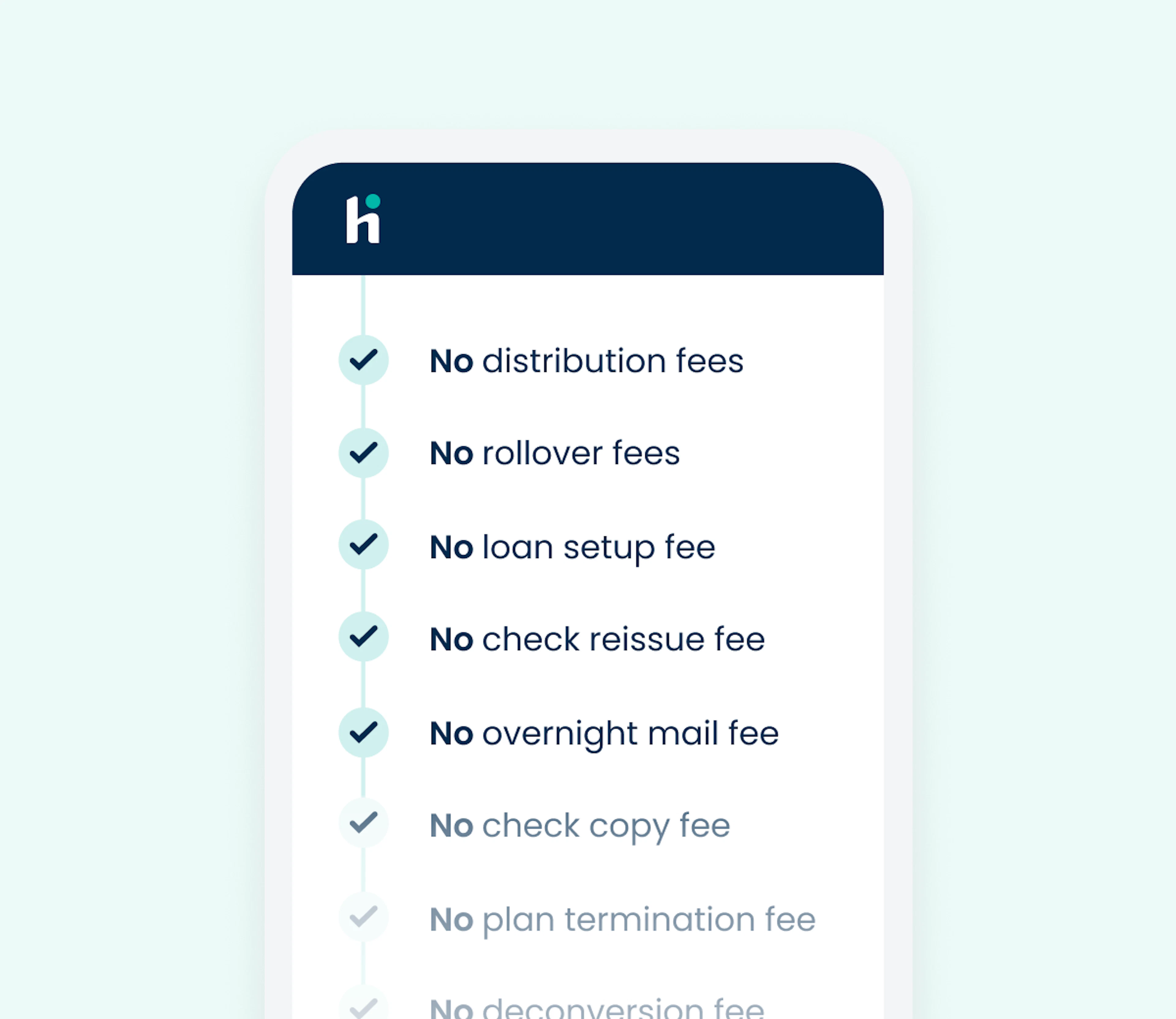
Flat monthly fees to run your plan. If a comparable plan costs less, that price should be matched.
A one-time setup fee of $499 may apply. A monthly investment advisory fee is paid to Human Interest Advisors (HIA) of 0.01% of plan assets when HIA acts as a 3(38) fiduciary, or 0.018% when acting as a 3(21) fiduciary. A separate fee for recordkeeping services and custody-related expenses is paid to Human Interest Inc. (HII) of 0.05% of plan assets. Asset-based fees are deducted monthly from the employee’s account according to the HII Terms of Service and HIA Terms of Service. All prices are exclusive of applicable taxes. If the plan sponsor elects to hire an external investment advisor, the plan sponsor will pay such advisor as agreed between the plan sponsor and advisor. An automatic rollover feature is available as an optional add-on to all plans for +$10/mo. With this feature, terminated employees with low balances are automatically rolled into an IRA.
*Applies to all transaction types. For non-rollover distributions, shipping and handling fees may apply to requests for check issuance and delivery.
Connect your existing payroll provider
600+ integrations that automatically enroll employees and process contributions.
Customer Testimonial
“I worked with two other 401(k) companies prior to Human Interest. We switched because they were so easy to work with. It’s seamless — they integrate with my payroll and support is fantastic.”
Human Interest solicited clients for testimonials. Solicitation may make a client more likely to portray Human Interest favorably. Testimonials may not be representative of the experience of others, and past success does not guarantee future results. Read our full disclosures.
401(k) resources for small business owners
401(k) Provider Comparison Guide
Compare 401(k) providers on compliance, pricing, and payroll integrations. Find the right retirement plan for your business.
401(k) plans for small business frequently asked questions
Currently, there’s no federal legislation requiring any employer to offer a retirement plan. However, since 2012, 48 states have either implemented a state-based retirement savings program, studied program options, or considered legislation in order to encourage people to save for their future. Additionally, there are a handful of states that have passed legislation requiring businesses to offer a state retirement plan to their employees if they do not offer another retirement plan such as a 401(k).
According to SHRM's 2025 Annual Benefits Survey, a 401(k) is the most-wanted benefit after health insurance.4
There are plenty of tax advantages for small businesses looking to start a 401(k). These advantages can come in the form of tax credits, which may apply to businesses that are looking to cover the costs of starting a 401(k) plan or make contributions to their employee’s 401(k) plan. According to the IRS, eligible employers may be able to claim a tax credit up to $5,000 for three years to cover the costs of starting a qualified retirement plan.
Employers can also deduct from the matching contributions they make to their employee’s 401(k) plans up to a maximum limit on their corporate tax returns.
According to the federal laws governing 401(k) plans, employees that are at least 21 years of age and have completed at least one year of service are eligible to participate in a 401(k) plan. This rule generally applies to both full-time and part-time employees. Employers may design their 401(k) plan with less restrictive eligibility requirements (e.g. age 18 and no service requirement). Employers may be able to exclude some employees from participation if they can meet certain coverage testing rules.
A plan recordkeeper administering a 401(k) plan may charge the sponsoring employer the following fees: a one-time startup fee, administration fees, and transaction fees. However, it’s difficult to get accurate ranges on a 401(k)’s average costs because a plan can vary widely. For example, total plan costs for a $1 million plan with 100 participants can range from 0.87% to 3.56%, depending on provider and structure.5
To change the provider of your 401(k) plan, contact your new 401(k) provider to help you transfer your assets and restate your retirement plan document. Once you’ve completed the entire transition process, your new 401(k) provider will take over the administration of your retirement plan. Changing your provider may take around two to three months.
Automatic enrollment is a retirement plan provision that automatically deducts funds from an employee’s wages to defer into their 401(k) account. Employers set the default election in the plan document, but employees can choose to opt out of plan participation at any time.
Employers may qualify for a tax credit of $500 each year for three consecutive years when adding an automatic enrollment feature to their new 401(k) plan.
Nondiscrimination testing (NDT) is required by the IRS to ensure that 401(k) plans do not unfairly favor highly compensated employees (individuals who received compensation of more than $135,000 if the preceding year is 2022, $150,000 if the preceding year is 2023, or owned more than 5% of a business at any time in the current year or the preceding year). These series of tests measure the participation rates of both highly compensated and non-highly compensated employees.
If an employer fails nondiscrimination testing, their 401(k) plan may lose its qualified status (although there are steps a business can take to correct failed NDT). At Human Interest, we monitor our client’s status to help them avoid failing nondiscrimination testing if possible. We also offer safe harbor 401(k) provisions, which are specifically designed to exempt employers from some major nondiscrimination tests.
Safe harbor match plans: Safe harbor match plans must provide a notice to participants at least 30 days in advance of the upcoming plan year that details certain plan provisions.
Deductibility deadline: Employer contributions must be deposited into the plan no later than the filing of the sponsor’s corporate return, including extension, in order for the contribution to be considered deductible.
Form 5500 deadline: Every year, a business must submit Form 5500 to document their company’s employee retirement plan and meet ERISA requirements. Failure to submit Form 5500 on time can result in hefty penalties. Calendar year plans must file Form 5500 by July 31 of the next year. This due date can be extended to October 15.
A 3(16) fiduciary is a service provider hired by an employer to function as a “Plan Administrator,” by fulfilling a comprehensive set of duties that many plan sponsors find demanding, including keeping the plan in compliance with ERISA guidelines. Overall, the purpose of a 3(16) fiduciary is to take on all or some of the employer’s fiduciary duties related to plan administration and reduce the administrative hassle involved in managing a 401(k) plan and its assets.
For example, rather than the employer having to work through issues like loan and distribution approval, a 3(16) fiduciary may do this for you. Some 3(16) fiduciaries will even handle signing and filing the annual Form 5500 required of many 401(k) plans. Not all service providers are willing to act as a 3(16) fiduciary and the exact 3(16) services provided vary from one provider to the next.
The IRS continues to help Americans save more for retirement by adjusting contribution limits for inflation. For 2026, the basic 401(k) contribution limit is $24,500, representing a $1,000 increase from 2025's limit of $23,500.
The catch-up contribution structure has become more nuanced to provide additional saving opportunities for those closer to retirement. Starting in 2026:
Participants aged 50-59 or 64 and older can make catch-up contributions of $8,000, bringing their total possible contribution to $32,500
Participants aged 60-63 can take advantage of an enhanced catch-up provision of $11,250, allowing for a total contribution of $35,750
This tiered approach to catch-up contributions reflects the SECURE 2.0 Act's goal of providing extra saving opportunities during the critical pre-retirement years. The enhanced catch-up provision for ages 60-63 is particularly significant as it offers an additional $3,750 in tax-advantaged saving capacity compared to the standard catch-up amount.
Notes
1
47,000 represents the total number of active employers with Human Interest retirement plans, based on the latest data available.
2
3% cash back is available to eligible individuals making $60,000 or less in gross income and contributing at least 8% of every paycheck to an eligible Human Interest plan over a 12-month period. Must submit a claim form to claim the award. Minimum award is $100 and max is $250. Additional requirements apply. See terms and conditions. This program is administered and offered by Human Interest, and Human Interest’s asset-based fees will increase if you participate in this program. If Human Interest’s wholly owned subsidiary and registered investment adviser, Human Interest Advisors LLC (“HIA”), provides services to the Plan, HIA’s asset-based fees will also increase if you participate in this program.
3
The ratio of new 401(k) plans launched is based on Human Interest’s internal analysis of self-reported, publicly available data from PLANSPONSOR (12/31/25), NAPA (6/30/25), DOL Form 5500 filings (1/9/26), and customer count data published on provider websites (12/18/25). This data may be incomplete, represents a point-in-time estimate, and is subject to change.