Affordable 403(b) retirement plans for tax-exempt organizations.
We listened and built what employers actually need — full-service 403(b) plans that reduce your workload, lower your compliance risk, and help you save money.
Retirement plans are complex. Let Human Interest guide you.
Old retirement plans place the burden on your team. We changed that with a 403(b) designed to run seamlessly in the background so you can focus on your cause.
Don't take on a second job.
Your provider should handle the work of running your plan, not you.
Eliminate surprises
Required annual testing, filings, notices, and audits shouldn't land on you or come with added fees.
Count on customer service
Dedicated U.S.-based customer service held to measurable standards, or you get compensated.
Offer a plan you're proud of
Prioritize low-cost strategies. Eligible savers can get 3% cash back on contributions.2
Get simple, predictable pricing
Flat monthly fees to run your plan. If a comparable plan costs less, that price should be matched.
A one-time setup fee of $499 may apply. A monthly investment advisory fee is paid to Human Interest Advisors (HIA) of 0.01% of plan assets when HIA acts as a 3(38) fiduciary, or 0.018% when acting as a 3(21) fiduciary. A separate fee for recordkeeping services and custody-related expenses is paid to Human Interest Inc. (HII) of 0.05% of plan assets. Asset-based fees are deducted monthly from the employee’s account according to the HII Terms of Service and HIA Terms of Service. All prices are exclusive of applicable taxes. If the plan sponsor elects to hire an external investment advisor, the plan sponsor will pay such advisor as agreed between the plan sponsor and advisor. An automatic rollover feature is available as an optional add-on to all plans for +$10/mo. With this feature, terminated employees with low balances are automatically rolled into an IRA.
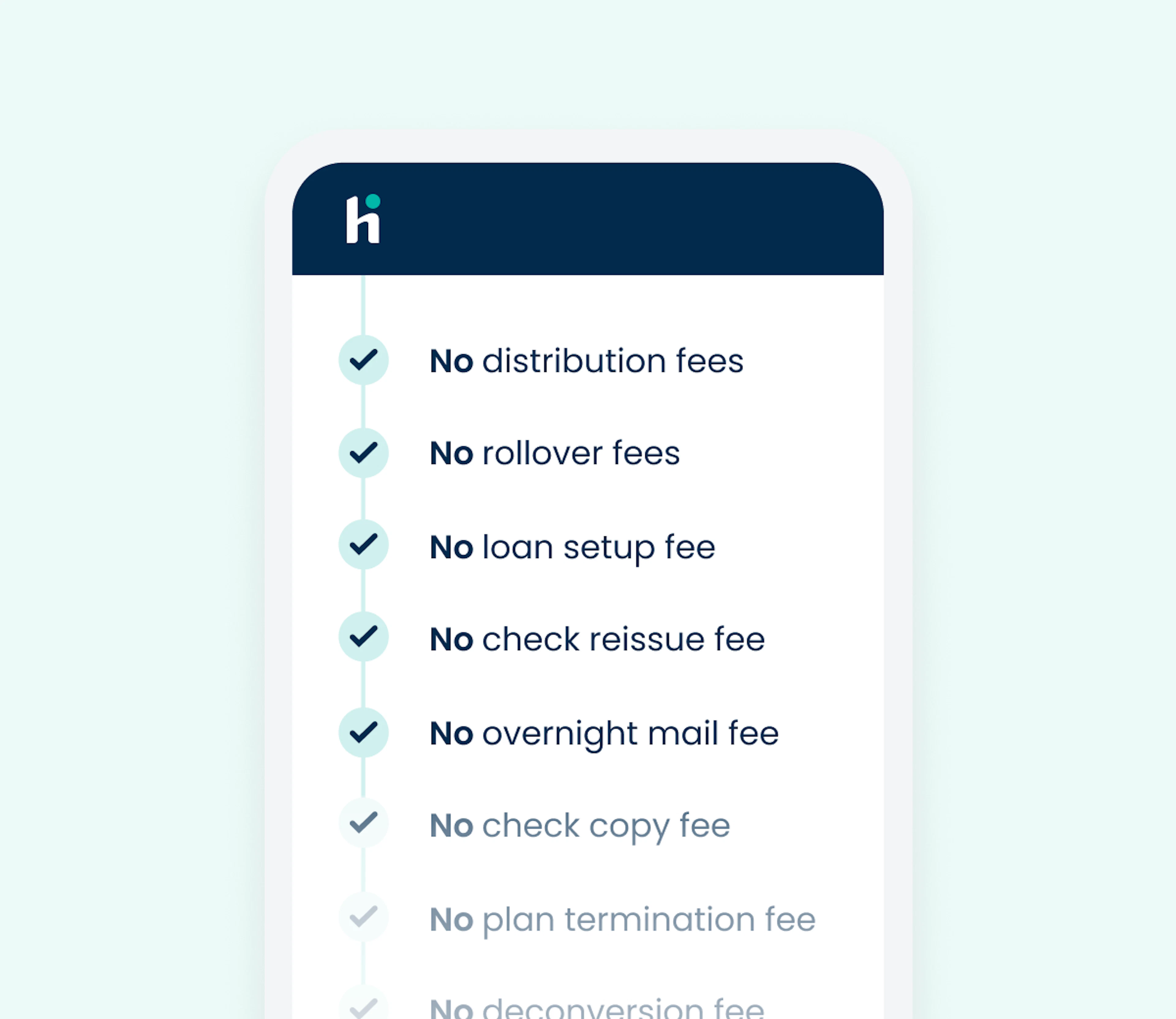
*Applies to all transaction types. For non-rollover distributions, shipping and handling fees may apply to requests for check issuance and delivery.
Connect your existing payroll provider
600+ integrations that automatically enroll employees and process contributions.
Customer Testimonial
“I worked with two other 401(k) companies prior to Human Interest. We switched because they were so easy to work with. It’s seamless — they integrate with my payroll and support is fantastic.”
Human Interest solicited clients for testimonials. Solicitation may make a client more likely to portray Human Interest favorably. Testimonials may not be representative of the experience of others, and past success does not guarantee future results. Read our full disclosures.
403(b) retirement resources
401(k) Provider Comparison Guide
Compare 401(k) providers on compliance, pricing, and payroll integrations. Find the right retirement plan for your business.
ERISA is the primary federal law that sets the requirements for employee retirement and welfare benefit plans. 403(b) plans sponsored by nonprofit 501(c)(3) organizations may be exempt from ERISA if they meet certain requirements. Note: Human Interest does not service non-ERISA plans.
The main difference between 403(b) and 401(k) plans is that a 403(b) plan can only be offered by tax-exempt organizations. These organizations include but are not limited to, public schools, 501(c)(3) institutions, or cooperative hospital service organizations.
403(b) plans are also exempt from most annual IRS nondiscrimination testing and can offer employees who have worked with a company for 15 years to make catch-up bonuses of $3,000 per year. 403(b) plans may only invest in mutual funds or annuities.
The primary difference between 401(a) and 403(b) plans is eligibility and plan design. 401(a) plans allow employers to require enrollment for eligible employees and set contribution models. 403(b) plans do not require enrollment into the plan.
403(b) plans have the same deadlines as most traditional 401(k) plans. Some of the major deadlines include:
January 15: Employers must submit the prior year’s census data to their plan’s recordkeeper. Census data is used to complete compliance testing.
March 15: Last day to distribute any required refunds to highly-compensated employees (HCEs) for failed ACP testing (403(b) plans are not subject to ADP testing).
July 31: Calendar year plans are required to file Form 5500, which must be submitted to the DOL to satisfy required annual reporting under ERISA. This due date may be extended until October 15.
December 31: Make any last-minute adjustments to your plan. This includes setting up a qualified retirement plan for the following year, signing plan document amendments, and distributing current year RMDs.
However, the main difference is that 403(b) plans are not subject to ADP, or Top Heavy testing. ADP testing is meant to ensure that the average rates of employee contributions and the related company match are proportionate between highly compensated employees and non-highly compensated employees.
Employees who are eligible to enroll in a 403(b) plan must be employees of one of the following:
501(c)(3) tax-exempt organizations
Public school systems
Public school systems organized by Indian tribal governments
Churches
Ministers
Self-employed ministers
Chaplains
For 2026, 403(b) contribution limits have been updated to provide more saving opportunities, especially for those approaching retirement. Here's a comprehensive explanation of the current limits:
Basic Contribution Limit: The base employee contribution limit for 403(b) accounts is $24,500 for 2026. This represents the maximum amount any eligible employee can contribute through salary deferrals during the year.
Age-Based Catch-Up Contributions: The catch-up contribution structure now has different tiers based on age:
For participants aged 50-59 or 64 and older: An additional $8,000 can be contributed, bringing their total possible contribution to $32,500
For participants aged 60-63: An enhanced catch-up amount of $11,250 is available, allowing for a total contribution of $35,750
Service-Based Catch-Up (15-Year Rule): A unique feature of 403(b) plans continues in 2026: Employees with 15 or more years of service at the same eligible organization may qualify for an additional catch-up contribution of up to $3,000. This special catch-up is available regardless of age and can be used in addition to the age-based catch-up contributions. To qualify, employees must have:
15 years of full-time service with the same eligible employer
Lifetime prior contributions must average less than $5,000 per year
A lifetime maximum additional contribution of $15,000
This means that in 2026, an eligible employee aged 60-63 with 15+ years of service could potentially contribute:
$24,500 (base contribution)
$11,250 (age-based catch-up)
$3,000 (service-based catch-up) For a total of $38,750
It's important to note that starting in 2026, employees who earned more than $150,000 in the previous year must make any catch-up contributions (both age-based and service-based) as Roth contributions rather than pre-tax contributions.
Notes
1
47,000 represents the total number of active employers with Human Interest retirement plans, based on the latest data available.
2
3% cash back is available to eligible individuals making $60,000 or less in gross income and contributing at least 8% of every paycheck to an eligible Human Interest plan over a 12-month period. Must submit a claim form to claim the award. Minimum award is $100 and max is $250. Additional requirements apply. See terms and conditions. This program is administered and offered by Human Interest, and Human Interest’s asset-based fees will increase if you participate in this program. If Human Interest’s wholly owned subsidiary and registered investment adviser, Human Interest Advisors LLC (“HIA”), provides services to the Plan, HIA’s asset-based fees will also increase if you participate in this program.
3
The ratio of new 401(k) plans launched is based on Human Interest’s internal analysis of self-reported, publicly available data from PLANSPONSOR (12/31/25), NAPA (6/30/25), DOL Form 5500 filings (1/9/26), and customer count data published on provider websites (12/18/25). This data may be incomplete, represents a point-in-time estimate, and is subject to change.